(III) Practices of the Three Traditions: Chan, Pure Land, and Esoteric Buddhism (三)禅、净、密三宗的修法
Compiled from Recordings of Master Yuanyin | 2018-06-23 | Download | First Proof
| 释迦牟尼佛和孔子差不多都是出生在周朝时期,佛教是在东汉时传到中国来的。经、律、论被誉为佛教的三藏经典。经是由佛讲述后人记载下来的;论是菩萨根据自己修行的心得编写的,如《大乘起信论》、《大智度论》等;律就是戒律,如比丘戒、沙弥戒、比丘尼戒等。三藏经典博大精深,像海洋一样难以探测。 | Śākyamuni Buddha and Confucius were born at approximately the same time, during the Zhou dynasty. Buddhism was transmitted to China during the Eastern Han dynasty. The sūtras, vinaya, and treatises are known collectively as the Buddhist Tripiṭaka. The sūtras record teachings spoken by the Buddha; the treatises were composed by Bodhisattvas on the basis of insights gained through their own practice, examples being the Awakening of Faith in the Mahāyāna and the Mahāprajñāpāramitā Śāstra; and the vinaya consists of codes of discipline, such as the precepts for bhikṣus, śrāmaṇeras, and bhikṣuṇīs. The Tripiṭaka is vast and profound, like an ocean whose depths are difficult to fathom. |
|---|
| 佛教最初传到中国的是禅宗(禅宗是佛教至高无上的正法门,净土宗是横超三界的方便法门)。禅宗可分为外道禅、小乘禅、世间禅和大乘禅。比如现在做气功的人,为把身体气脉打通,练气打坐,目的在气上。 | The first school of Buddhism introduced to China was Chan Buddhism (the supreme and orthodox Dharma), while Pure Land Buddhism serves as a more accessible means to transcend the three realms. Chan can be categorized into non-Buddhist Chan, Lesser Vehicle Chan, worldly Chan, and Mahāyāna Chan. For instance, some individuals practice qigong to open their body's energy channels through meditation, concentrating on the qi itself. However, practicing with ulterior motives falls under the category of non-Buddhist Chan. |
|---|
| 这样带异计而修者就是外道禅。“异计”就是不是为了了生死,而是求其他的目的。比如:让我们的身体健康些,长寿些。更有甚者是为了得到神通,来炫耀自己,获得点名闻利养等等。这些都是带异计而修的,都是外道禅。 | "Ulterior motives" refers to pursuing goals that do not align with the liberation from the cycle of birth and death. Some people, for example, cultivate to enhance their health and longevity, while others seek to acquire spiritual powers, gain recognition, and achieve fame and fortune. These pursuits represent non-Buddhist forms of Chan, driven by ulterior motives. |
|---|
| 如果是为了了生死,但只懂得色身无我,以偏空之理而修的是小乘禅。因为他法执未除,执着佛性七大种性(地、水、火、风、空、根、识)当中的地、水、火、风四大种性为我,是为法我,叫做法见未除。 | If one wishes to end birth and death but understands only that the body has no self, and practices according to the principle of biased emptiness, one practices Small Vehicle Chan. Because attachment to dharmas has not been removed, one clings to the four elements of earth, water, fire, and wind, among the seven great elements of Buddha-nature (earth, water, fire, wind, space, faculties, and consciousness), as the self. This is dharma-self, and it is called not having removed the view of dharmas. |
|---|
| 这种以偏空真理而修者,是为小乘禅(“偏空真理”有的字典称为“偏真空理”,即偏执我空之真理而不知法亦空,若悟我、法二空,无可执取,则空有双融而代偏空矣。此种偏见亦可说为“我空偏真”之理)。 | Some dictionaries refer to the "biased truth of emptiness" as clinging to the notion of self-emptiness without recognizing that the Dharma is also empty. If one comprehends the emptiness of both self and Dharma, there is nothing to grasp; in this case, emptiness and existence become integrated, replacing the biased view of emptiness. This form of prejudice is referred to as the principle that "the emptiness of self is a biased truth." |
|---|
| 以四禅八定的禅法而修者,是为世间禅。假如明白了人法俱空,人我没有了,法我也没有了,以此而修者,是为大乘禅。当然没有法我,不是说没有法身,而是说法身的四大种性也不执着。 | Those who practice the four dhyānas and eight samādhis are engaging in worldly Chan. Mahāyāna Chan is practiced this way if one knows that both self and phenomena are empty. The absence of a self in phenomena implies the presence of the Dharmakāya, but one is not attached to the four elements of the Dharmakāya. |
|---|
| 就像我们人有眼睛、耳朵、鼻子、嘴巴,既不执着局部的感官,也不住执整个身体。我们的法身本来就具足地、水、火、风这四大种性,但不可执着这四大种性为我,一有所住,就是法有我。 | Just as we humans have eyes, ears, a nose, and a mouth, we are neither attached to the local senses nor to the entire body. Our Dharmakāya inherently possesses the four elements of earth, water, fire, and wind, but we must not cling to these four elements as self. The moment we cling to anything, it is as if phenomena have a self. |
|---|
| 学大乘禅的人悟人、法双空,毫无偏执。了人无我,可了分段生死;了法无我,则了变易生死。分段生死就是六道轮回的生死。以每次生死皆有个身形,在世上生存一段时间。人有人身,马有马身,狗有狗身。 | Those who practice Mahāyāna Chan realize the emptiness of both person and dharmas, without one-sided attachment. Realizing that the person is without self enables one to transcend segmented birth and death; realizing that dharmas are without self enables one to transcend transformational birth and death. Segmented birth and death is birth and death within the six realms. Each life has a bodily form that exists in the world for a certain period: human beings have human bodies, horses have horse bodies, and dogs have dog bodies. |
|---|
| 这个身体生存就是生,坏了就是死,这就叫分段生死;变易生死就是我们的思想一生一灭,变化无穷。了了六道轮回的生死,叫了分段生死。了了思想变易的生死,叫了变易生死。 | This physical body's existence is birth, and its decay is death—this is called the segmented birth and death. The transformational birth and death is the arising and ceasing of our thoughts, infinitely changing. Understanding the segmented birth and death is called transcending the segmented birth and death. The understanding of the ever-changing nature of thought and the cycle of birth and death is called transcending the transformational birth and death. |
|---|
| 一切法根本不可得,认为有法可得,法有真实受用,那就是法见未除。就是法有我,就不能了变易生死。所以罗汉是证偏空真理。而证入人法都空的真理就是菩萨。 | All dharmas are fundamentally unattainable; to believe that dharmas are attainable or have real benefits is to have not eliminated the view of dharma. It means that dharma has a self, and thus one cannot transcend the transformational birth and death. Therefore, Arhats have realized the partial truth of emptiness. A Bodhisattva realizes the truth that both self and dharma are empty. |
|---|
| 再进一步,就是认识到我们的法身(就是能够见、能够闻、能够嗅、能够触、能够知的觉性)与诸佛无二无别,用这个真理来修的,就是最上乘禅。修此禅者,须时时刻刻观照,一点妄念都不起。 | Going further, one recognizes that our Dharmakāya (the awareness that can see, hear, smell, touch, and know) is no different from that of all Buddhas. Cultivating this truth is the Supreme Vehicle Chan. Those who cultivate this meditation must constantly observe, without giving rise to even the slightest deluded thought. |
|---|
| 妄念一起,就把它化空,不跟着它跑,任何境界变现在前也不为所动,久久地这样锻炼下去,就会将身心、世界化空,而亲证本来——佛性。当然一下子做不到,这个念头才息下来,那个念头又来了,须要不停的与它斗争下去。 | As soon as a deluded thought arises, it dissolves into emptiness; one does not cling to it. One remains unmoved by any appearance of phenomena. Through prolonged practice in this manner, one can empty the body, mind, and the world, directly realizing one's original nature—Buddha-nature. Such realization cannot be achieved immediately; as soon as one thought subsides, another arises, necessitating a continuous struggle against it. |
|---|
| 在起念时,我们要看见它,不跟它跑,不理睬它,它有一百个起,我有一百零一个不理不睬,在这样不理不睬的斗争当中,念头就不期然而然的化掉了。当你一念不生时,忽然“唰……”的一下,能所双亡,根尘脱开了。 | When a thought arises, we must acknowledge it without chasing after it, allowing it to pass. If a hundred thoughts arise, I will ignore them a hundred and one times. In this ongoing struggle of ignoring and letting go, thoughts will naturally dissipate. When not a single thought arises, suddenly, "whoosh..." the distinction between subject and object disappears, and the sense faculties and their objects fall away. |
|---|
| 当下身心(就是思想)、世界与虚空,一齐消殒无存,天真的佛性也就历然现前而亲证本来了。如此修习,就是无上的、最高的“大乘禅”!达摩祖师传给我们的就是这种禅。 | At that moment, the body and mind (that is, thought), the world, and emptiness vanish completely, and pristine Buddha-nature stands vividly revealed that enables us to personally realize our original essence. This kind of practice represents the supreme and highest form of "Mahāyāna Chan." This meditation is the Chan that Bodhidharma transmitted to us. |
|---|
| 前面几种禅,趣入虽有门户次第,然如能一门深入,虔诚修习,皆得功用,不可轻视蔑弃也。达摩未来之前,行者都是修“四禅八定”的禅法,成道的人很多。 | Despite their different methods and orders, all Chan types are effective if one engages with and practices them sincerely. Before Bodhidharma's arrival, practitioners primarily engaged in the "Four Dhyānas and Eight Samādhis," and many attained enlightenment. |
|---|
| 唐、宋以来,大都修达摩祖师的所传的祖师禅,因我国固有的儒教与道教的高深文化,集合达摩所传的禅法,酿成独特的禅风,因之证道的人更多。这些都有历代相续的、真实的历史记载,可以追踪查考。 | Since the Tang and Song dynasties, most people have practiced the patriarchal Chan passed down by Bodhidharma. The profound influence of Confucianism and Taoism in my country, combined with the Chan methods imparted by Bodhidharma, has led to the development of a unique Chan style, resulting in more individuals attaining enlightenment. All of this is supported by authentic historical records from various dynasties, which can be traced and verified. |
|---|
| 达摩所传的祖师禅不立文字,直指人心,见性成佛。就是直接告诉我们什么是佛。那时候人的根性好,只怕不知道,一旦知道了什么是佛,就会绵密保护,不让习气沾染上去。时时观空不再着相,用不了几年就能成就,快得很。 | The Chan of the Patriarchs, transmitted by Bodhidharma, does not rely on written words but points directly to the mind, revealing one's true nature and attaining Buddhahood. It directly tells us what Buddhahood is. People at that time had excellent innate qualities; the only problem was that they didn't know. Once they knew what Buddhahood was, they would diligently protect themselves, preventing habitual tendencies from taking hold. Constantly contemplating emptiness and no longer clinging to appearances, they could achieve enlightenment in just a few years—very quickly. |
|---|
| 所以达摩祖师所传的顿悟禅非常好,用不着怎么修法,因为我们本来是佛,就是我们不知道。比如六祖大师指示惠明说:“不思善,不思恶”一切放下,什么念头都不动。“惠明良久”,就是停到那儿不动了。 | Therefore, the sudden enlightenment Chan transmitted by Bodhidharma is excellent. It doesn't require much practice because we are inherently Buddhas; we just don't know it. For example, the Sixth Patriarch instructed Huiming, "Do not think of good, do not think of evil, letting go of everything, without any thought. "Huiming remained still for a long time," meaning he stopped there, without a single thought arising. |
|---|
| 不动的时候一念不生,六祖大师就直接指示他:“正与么时,那个是你明上座本来面目。”就是正在这个一念不生的时候,你不是木头石头(木头石头没有知觉)而是了了分明,“那个”就是你的本来面目。 | While he remained unmoving, not a single thought arose, and the Sixth Patriarch directly instructed him, "At that very moment, that is your Original Face, Venerable Huiming." That is, at this moment of no thought arising, you are not a piece of wood or stone (wood and stone have no consciousness) but are clearly aware; "that" is your Original Face. |
|---|
| 这就是直接指示,多好啊!后来人不明白这个道理,“那个”就变成了“哪个”了。“‘哪一个’是你明上座本来面目?”就成问话叫你去参了。就像猜谜一样:哪一个?哪一个?其实六祖大师不是这样问的,他是直接指示。 | This is direct instruction—how wonderful! Later people didn't understand this principle, and "that" became "which one." "Which one is your Original Face, Venerable Ming?" This becomes a question, inviting you to contemplate. It's like a riddle: Which one? Which one? Actually, the Sixth Patriarch didn't ask it this way; he gave direct guidance. |
|---|
| 就像于頔大夫问紫玉禅师:“如何是佛?”禅师就喊他:“于岫大夫!”大夫答应道:“唉”。“即此是!”紫玉禅师说:就是答应的这个就是。于是于岫大夫就开悟了。 | It's like when Official Yu Xiu asked Chan Master Ziyu, "What is Buddha?" The Chan Master called out, "Official Yu Xiu!" The doctor replied, "Yes." "This is it!" Chan Master Ziyu said: It is the one who answered. And so Official Yu Xiu attained enlightenment. |
|---|
| 多么简单痛快啊!那么于岫大夫是不是真正开悟了呢?脚跟是否点地呢?后来药山禅师(即石头希迁的徒弟)想考考于岫大夫就说:“哎哟,恐怕大夫埋到紫玉山中去了。 | How simple and straightforward! But was Official Yu Xiu truly enlightened? Did he truly touch the ground? Later, Chan Master Yaoshan (a disciple of Shitou Xiqian) wanted to test Official Yu Xiu, so he said, "Oh dear, I'm afraid you've been buried in Ziyu Mountain." |
|---|
| ”于岫大夫听到之后想:是不是我悟错了?赶快又去参拜药山说:“请大师开示?如何是佛?”药山也是这样喊他:“大夫!”于岫大夫答应道:“唉!”这回药山换了一句话问:“是什么?”于岫大夫,“噢……”这次他真的开悟了。 | Upon hearing this, Official Yu Xiu thought: “Did I get it wrong?” He hurriedly went to call on Yaoshan again and said, “Master, please instruct me: what is Buddha?” Yaoshan again called out to him, “Official!” Yu Xiu answered, “Yes!” This time Yaoshan changed his words and asked, “What is it?” Yu Xiu said, “Oh…” This time he truly awakened. |
|---|
| 紫玉禅师说:“即此是!”就是告诉于岫大夫这就是佛。药山反问:“是什么?”也是告诉于岫大夫这就是佛了。这些都是直接指示。后来就不行了,因为后来人根陋劣,你这样直接告诉他,他反而不以为奇。 | Chan Master Ziyu said, "This is it!" which meant telling Official Yu Xiu that this was Buddha. Yaoshan asked in return, "What is it?" which also meant telling Official Yu Xiu that this was Buddha. These were all direct instructions. Later, it didn't work anymore because people’s spiritual capacities had become shallow. If you told them directly, they wouldn't consider it amazing. |
|---|
| 就像祖上遗下的财产一样,不是自己血汗挣来的就不当一回事,滥花滥用。如果直接指示他,他还说:“这就是佛呀?那怎么没有神通,没有辩才呢?恐怕不是吧。”他就不能承当,更谈不上保任。 | It is like property left by one’s ancestors: since it was not earned by one’s own sweat and blood, one does not take it seriously and squanders it. If you point it out directly, he says, “This is Buddha? Then why does it have no spiritual powers and no eloquence? I doubt that’s it.” He cannot take it on, much less safeguard it. |
|---|
| 所以禅宗到后来就变成起疑情参话头了,直到现在就参一句死话头:“念佛是谁?”参几十年都得不到消息。因为根本起不了疑情。 | So Chan later became about arousing doubt and contemplating koans. Even now, people contemplate a dead koan: "Who is reciting the Buddha's name?" They contemplate it for decades without getting any results because they simply can't arouse doubt. |
|---|
| 参话头是要起疑情:念佛究竟是谁念的呢?是我念的,那么什么是我呢?身体是我吗?身体是地、水、火、风四大假合,假如我们一口气不来了,肉身实体没有烂掉,那时为什么不能念了?所以身体不是我。 | The key to koan practice is to cultivate doubt: Who is reciting the Buddha's name? It is I who am reciting it, but then what is "I"? Is the body "I"? The body is a temporary composite of the four elements: earth, water, fire, and wind. If we were to stop breathing, and our physical body hadn't decayed, why couldn't we recite the name? Therefore, the body is not "I." |
|---|
| 思想是我吗?思想是外界客观环境在人脑中的反映。没有外界客观环境就没有思想,所以思想也不是我。那么“阿弥陀佛”这句佛号究竟是谁念的?要把这个问题的答案找出来,就要起疑情。 | Is thought "I"? Thought is a reflection of the external environment in the human brain. Without an external objective environment, there would be no thought; therefore thought is not the self either. Then, who is reciting the Buddha's name, "Amitābha"? To discover the answer to this question, one must cultivate doubt. |
|---|
| 因为疑情一起,一直思索这个问题,究竟是谁?这样就把思想妄念截断了。思想被这个疑情抓住,就不会胡思乱想了。不然我们妄念多端,一分一秒都没有停止过。即使是睡着了也没有停止的时候,还是妄念多端,乱梦横生。 | Because once doubt arises, one keeps pondering this question: Who is it? This process cuts off deluded thoughts. This doubt grasps the mind, preventing it from wandering aimlessly. Otherwise, our deluded thoughts are endless, never ceasing for even a second. Even when asleep, they don't stop; they are still full of deluded thoughts and chaotic dreams. |
|---|
| 所以禅宗人说的:“大疑大悟,小疑小悟,不疑不悟。”就是这个道理。因为疑情不起,思想总是在动,就抓不住,就不能深入禅定,妄心就息不下来,本性就不能现前。因为真心都被妄念包裹着看不见了。 | Therefore, the Chan masters say, "Great doubt, great enlightenment; small doubt, small enlightenment; no doubt, no enlightenment." This is the principle. Because doubt doesn't arise, thoughts are constantly in motion, making it impossible to grasp anything, deepen meditation, calm the deluded mind, and reveal one's true nature. Deluded thoughts obscure the true mind. |
|---|
| 我到过几个寺院,看他们在那里念念有词:念佛是谁,念佛是谁……。哎!真糟糕,他们没有起疑情,在那里念“念佛是谁?”还不如念阿弥陀佛好呢!念阿弥陀佛还有佛号的果地感应,还有佛因地发心功德的加持,比念“念佛是谁”要得力的多。 | I've visited several temples and seen them chanting, "Who is reciting the Buddha's name? Who is reciting the Buddha's name…" Alas! It's terrible! They haven't developed doubt; chanting "Who is reciting the Buddha's name?" is far less effective than reciting Amitābha Buddha's name! Reciting Amitābha Buddha's name has the resonance of the Buddha's fruition embodied in the Name and the empowering merit of the Buddha's causal vows, making it far more powerful than chanting "Who is reciting the Buddha's name?" |
|---|
| 现在是末法时代,佛法衰微,大家都不肯好好的用功修法。现在的禅宗说起来真凄惨,所传之法,都不是自己亲自证到本性后,再传给他人,而以法卷代传。 | We are now in the Dharma-ending Age. The Buddhadharma is in decline, and people are unwilling to apply themselves properly to practice. The present condition of Chan is truly lamentable. Those who transmit it have not personally realized their true nature before passing the Dharma to others; instead, transmission is represented by a lineage scroll. |
|---|
| 就像我们画图画的画卷一样,用一张长长的画纸,在上面写上四个大字:“正法眼藏”。 | Like a painted handscroll, it is a long sheet of paper bearing the four large characters “Treasury of the True Dharma Eye”. |
|---|
| 然后写第一代祖师是谁,第二代祖师是谁,第三、第四……传到我这儿现在是第三十四代,我传给了你,就写第三十五代,把这卷子传给你,就算是把法传给你了。传的人既没有悟道,受的人也没有悟道,大家就这样糊里糊涂地把卷子传下去,就算悟道了,就算法有传承了,这样的传接法,禅宗哪得不扫地?! | It then names the first patriarch, the second, the third, the fourth, and so forth. If I am listed as the thirty-fourth generation and transmit it to you, I write in the thirty-fifth generation and hand you the scroll; this is then regarded as transmitting the Dharma. Neither the transmitter nor the recipient has awakened to the Way, yet in their confusion they continue passing down the scroll and call this awakening and an authentic lineage. With transmission conducted in this way, how could Chan not be brought into disrepute? |
|---|
| 禅宗产生很长时间后,才出现了净土宗。净土宗是在东晋时,由庐山东林寺的慧远法师设立的。 | The Pure Land school arose long after Chan. It was established during the Eastern Jin dynasty by Dharma Master Huiyuan of Donglin Temple on Mount Lu. |
|---|
| 当时,慧远法师看很多人参禅不对机,就设了两个佛堂:一个是禅堂,一个是依据三经(即《阿弥陀经》、《无量寿经》、《观无量寿佛经》)设立的念佛堂。让参禅不对机的人入念佛堂,于是就产生了净土宗。 | Seeing that Chan practice did not accord with the capacities of many people, Huiyuan established two halls: a Chan hall and a Buddha-recitation hall based on the three sūtras—the Amitābha Sūtra, the Sūtra of Infinite Life, and the Sūtra of Contemplation of the Buddha of Infinite Life. Those whose capacities were unsuited to Chan entered the Buddha-recitation hall, and in this way the Pure Land school arose. |
|---|
| 净土宗比较方便,借佛的慈悲力量接引,横超三界,往生西方极乐世界。但要真正做到一心不乱才行。关于一心不乱在净土宗里横起纷争。 | Pure Land is a comparatively accessible method: relying upon the Buddha's compassionate power of reception, practitioners transcend the Three Realms horizontally and attain rebirth in the Western Pure Land of Ultimate Bliss. Yet they must genuinely attain one-pointed, undisturbed mind. This requirement has caused much controversy within the Pure Land school. |
|---|
| 有些人说:“我们全仗佛力,不要一心不乱,散心念佛就行了(散心念佛就是一面嘴上念,一面思想乱动)。”还有的说:“恐怕不行吧!佛说要执持名号一心不乱,才能彼佛现前接引往生。”所以净宗行人也有分歧。 | Some say, “We rely entirely upon the Buddha's power. We do not need one-pointed, undisturbed mind; reciting with a scattered mind is enough.” Reciting with a scattered mind means that the mouth recites while thoughts continue to wander. Others reply, “Surely that cannot be right. The Buddha taught that we must hold fast to the Name with one-pointed, undisturbed mind; only then will that Buddha appear, receive us, and enable our rebirth.” |
|---|
| 是不是要一心不乱呢?假如马马虎虎念佛就能往生,为什么憨山大师还说:“口念弥陀心散乱,喉咙喊破也徒然”呢?所以还是需要一心不乱的。 | Pure Land practitioners are therefore divided over whether one-pointed, undisturbed mind is necessary. If casual Buddha-recitation were sufficient for rebirth, why did Master Hanshan say, “Reciting Amitābha with the mouth while the mind is scattered is futile, even if one shouts until one's throat is hoarse”? One-pointed, undisturbed mind is still required. |
|---|
| 关于一心不乱也有深浅,分起来很详细:有事一心,理一心,理事一心,事事一心。我们不讲深的,讲最简单的,就是佛号要时时刻刻在心中念:阿弥陀佛,阿弥陀佛……。 | It has several levels: one-pointedness in phenomena, in principle, in principle and phenomena, and in phenomena and phenomena. We shall not discuss the profound levels, but only the simplest. The Buddha's name must remain in the mind at every moment: “Amitābha Buddha, Amitābha Buddha…” |
|---|
| 遇到再好的境界也不乐而忘形,还是阿弥陀佛,阿弥陀佛……;遇到再坏再烦恼的境界也不烦恼,还是阿弥陀佛,阿弥陀佛……,心不动摇。这是事一心不乱。要能做到这样才行。假如连这个也做不到,我看生西方就很困难。 | Whatever good state one meets, one does not become overjoyed and forget oneself, but goes on with Amitābha Buddha, Amitābha Buddha…; whatever bad or troublesome state one meets, one is not troubled, but goes on with Amitābha Buddha, Amitābha Buddha…, the mind unshaken. This is one-pointedness at the level of phenomena. One must be able to do at least this. If one cannot even do this, I think rebirth in the West will be very difficult. |
|---|
| 因为佛不是跑到你面前来接引你。永明寿禅师曾在《宗镜录》中讲:佛就好比是天上的月亮,在千江万水中都显现,我们的心就好比是千江万水。一心不乱就像清水,阿弥陀佛只能在清水中显现。 | The Buddha does not run up before us to receive us. In the Zongjing lu, Chan Master Yongming Yanshou says that the Buddha is like the moon in the sky, reflected in a thousand rivers and ten thousand streams, while our minds are like those waters. One-pointed, undisturbed mind is like clear water, in which alone Amitābha Buddha can appear. |
|---|
| 假如我们的心污七八糟就像一潭浑水,佛就是来了你也见不到。因为大家都不肯好好用功,所以本书中说:在现在的末法时代,连“普遍通行的‘净土宗’念佛法门也难方便实行了”。 | If the mind is filthy and confused, like a pool of muddy water, we will not see the Buddha even when he comes. Because people are unwilling to practice diligently, this book says that in the present Dharma-ending Age, even the widely practiced Pure Land method of Buddha-recitation has become difficult to carry out as an accessible practice. |
|---|
| 净土宗其实是很容易方便实行的,就是念一句佛号:“阿弥陀佛”。但为什么又说:“难以实行”呢?因为现在的修行人不肯用功念佛,都是在装模作样,上上早殿,上上晚殿,敲敲唱唱就算功课做好了。 | The Pure Land school is in fact easy and accessible to practice: one simply recites the Buddha's name, “Amitābha Buddha”. Why, then, is it said to be “difficult to practice”? Because practitioners today are unwilling to apply themselves to Buddha-recitation. They merely put on appearances: attending morning and evening services, striking instruments and chanting, and then considering their daily practice complete. |
|---|
| 这还是比较好的,差一些的,连殿也不上,只想做经忏挣钱。这样修行有用处吗?一点用处也没有!念佛求生西方,要念到一心不乱才行。佛说:“欲净其土,先净其心;随其心净,即佛土净。 | These are the better ones. Those who are worse do not even attend services; they think only of earning money by performing sūtra recitations and repentance rites. Is such practice of any use? None at all. To seek rebirth in the West through Buddha-recitation, one must recite until the mind is one-pointed and undisturbed. The Buddha said, “If you wish to purify your land, first purify your mind; as your mind becomes pure, so does the Buddha-land.” |
|---|
| ”心不清净,与净土不相应,是不能往生净土的。佛在《观经》中讲,念佛法门有十六种观法,最后一观叫念佛观。应该怎么观呢?就是念佛时,须心念耳闻,就是说念佛时,耳朵能够清清楚楚地倾听自己的念佛声音。 | An impure mind does not correspond to the Pure Land and cannot be reborn there. In the Contemplation Sūtra, the Buddha teaches sixteen contemplations; the last is the contemplation of Buddha-recitation. How is it practiced? While reciting, one must “recite with the mind and hear with the ears”: the ears listen clearly to the sound of one's own recitation. |
|---|
| 这种观法,不是用眼睛看,而是用耳朵来观照我们念佛的声音。以耳根摄定意根,使其不生妄念而达到进入念佛三昧的目的。我们真能证入念佛三昧,当腊月三十日到来时,绝定能生西。否则,就很难说了。 | This contemplation does not use the eyes to look; it uses the faculty of hearing to illuminate the sound of Buddha-recitation. The ear faculty gathers in the mental faculty so that deluded thoughts do not arise, leading to the Buddha-recitation samādhi. If we genuinely enter this samādhi, when the final day comes we shall certainly attain rebirth in the West; otherwise, the outcome is difficult to predict. |
|---|
| 因此,念佛须一切放下,静静地念:“阿弥陀佛、阿弥陀佛……”同时用耳朵静听自己念佛的声音,才能摄心入观。现在的人念佛不入观,不肯照佛教导的方法来切实实行,所以收效甚微。 | We must therefore let go of everything and quietly recite, “Amitābha Buddha, Amitābha Buddha…”, while listening calmly to the sound of our own recitation. Only then can we gather the mind and enter contemplation. People today recite without entering contemplation and are unwilling to put the Buddha's instructions earnestly into practice; consequently, they achieve very little. |
|---|
| 大势至菩萨教导我们:“都摄六根,净念相继。”就是教导我们念佛,须把眼、耳、鼻、舌、身、意这六根,都摄在这一句佛号上。 | The Bodhisattva Mahāsthāmaprāpta teaches us, "Gather in all six sense faculties and maintain uninterrupted pure mindfulness." This instruction signifies that, while reciting the Buddha's name, we must focus all six sense faculties—eyes, ears, nose, tongue, body, and mind—on this single name. |
|---|
| 眼睛不看别的东西,耳朵不听别的声音(只听我念佛的声音),鼻子不闻什么香臭,舌头也不尝什么味道,不说话。竭尽心力,“阿弥陀佛、阿弥陀佛……”静静地一直念下去,自然渐渐息下妄心而安然入定。 | The eyes do not look at other things; the ears hear no other sounds, but listen only to one's own recitation; the nose does not follow pleasant or unpleasant smells; the tongue neither tastes flavours nor speaks. Exert all your strength, quietly and continuously reciting, "Amitābha, Amitābha..." Gradually, deluded thoughts will subside, allowing one to enter a state of Samādhi. |
|---|
| 可惜现在净宗行人不肯这样做。说到“净念相继”这句话,意义深长,确实很难做到。因为不是照字面看起来那么简单,不是只静静地念这句佛号,就叫净念相继,而是很深的,像禅宗开悟后保任到家的功夫一样。 | Unfortunately, many Pure Land practitioners today seem reluctant to do this. The phrase "uninterrupted pure mindfulness" carries profound meaning and is quite challenging to attain. It is not as straightforward as it may appear; it involves more than simply reciting the Buddha's name quietly. This practice is deeply profound, akin to the maturation of post-awakening preservation in Chan Buddhism. |
|---|
| 所谓净者,要能所双亡,根尘脱落才叫净。就是念佛时能念的心和所念的佛号,一时脱落,无能无所,廓尔清净,才是一念净。有念佛的心和所念的佛号,有能有所,这是相对的。相对的都是虚妄不实的。绝对的才是真的。 | True purity necessitates the dissolution of both subject and object, liberating the senses and their corresponding objects. This means that, while reciting the Buddha's name, both the mind engaged in recitation and the name itself must simultaneously fade away, leading to a state of serene purity—this represents a singular moment of pure mindfulness. The intention to recite the Buddha's name and the name being recited are both relative concepts. Relative phenomena are illusory and unreal. Only the absolute is true; |
|---|
| 唯有我们的佛性是绝对的。你现在念佛,心、法、佛号都是相对的,所以这不是净念。 | Only our Buddha-nature is absolute. When you recite the Buddha’s name now, the mind, the dharma, and the Buddha’s name are all relative, so this is not pure mindfulness. |
|---|
| 要等念佛念得入定了,念得能所脱掉了,就像我们修心中心法一样,持咒持到最后,“啪——”脱掉了,法没有了,人也没有了,心也没有了,世界也没有了,都空净了,但灵知了了,这才是一念净。 | You must wait until you attain a state of deep concentration in your recitation, transcending the duality of subject and object, akin to the practice of the Heart-of-Heart Dharma. One continues reciting the mantra until, suddenly—“pa!”—everything falls away—the Dharma is gone, the person is gone, the mind is gone, the world is gone—everything becomes empty and pure, yet your lucid knowing remains vividly clear. Only this is the purity of a single thought. |
|---|
| 一念净就是一念相应,这一念就是佛。一念相应一念佛,念念相应念念佛。念念都是如此不动,念念都是佛,这才叫做相继不断!你们看这是何等的功夫啊!讲到“相应”,还有静中的相应和动中的相应不同。 | The purity of a single thought is one thought in harmony; this single thought embodies Buddha. One thought in harmony equates to one thought of Buddha; every thought in harmony reflects every thought of Buddha. Each thought remains unmoved like this; every thought is Buddha—this single thought is what is meant by “maintaining pure mindfulness continuously". Reflect on the level of skill demonstrated here! When discussing " maintaining pure mindfulness," it is crucial to differentiate between maintaining pure mindfulness within stillness and maintaining pure mindfulness within movement. |
|---|
| 静中相应,就是我们打坐的时候,能所双亡,打开了本来,与佛相应。但下座动中又忘记了,跟着外境跑了,就不相应了。所以这只是静中相应,动中不相应还是不行。 | Maintaining pure mindfulness within stillness indicates that during meditation, both subject and object are extinguished, revealing our original nature and allowing us to align with Buddha. However, when we rise and move, we frequently forget our true selves, yielding to external influences and thereby losing that mindfulness, which can lead to a disconnection from our original nature and the insights gained during stillness. Consequently, while maintaining pure mindfulness within stillness is the primary objective, maintaining pure mindfulness within movement is also vital. |
|---|
| 功夫须做到动静一如,动中不跟境界转,仍然是了了分明,如静中一样才行,这就更难了。相继就是继续不断,就是不问动静,时时如此,不只是一时如此,而他时如彼。 | The skill must develop to a point where stillness and movement merge, maintaining mindfulness in movement just as in stillness. This process is even more demanding. "Maintaining" refers to uninterrupted awareness, regardless of whether one is in movement or stillness, consistently remaining in the same state—not just for a moment but at all times. |
|---|
| 因为我们旧习深重,打坐用功,常是今天能脱开,明天又脱不开,要等多少天后才脱一次,以后不再脱开,那是瞎猫碰着死老鼠,非但不是相继的功夫,也不算开悟。 | Our deeply rooted habits mean that we may break through in meditation today but be unable to do so tomorrow. We may have to wait many days for another breakthrough, and it may never happen again. That is like a blind cat stumbling upon a dead mouse: it is neither continuous practice nor awakening. |
|---|
| 纵然功夫增进,静中能相继了,动中有走着,还不能算相继成片的功夫。真正的相继,须动中也如静中一样相继。就是在做事时尽管在做,却等于没做,丝毫不住着。做过之后,更没有丝毫做的痕迹。做到这样动静一如的相继,才叫净念相继。 | Even when practice improves and continuity is possible in stillness, it is not yet continuous and undivided practice if one goes astray in activity. True continuity must be maintained in activity just as in stillness. While fully engaged in a task, one acts as though nothing had been done, without the slightest abiding attachment. Afterward, not even a trace of having acted remains. Only such continuity, equally at ease in stillness and activity, is called uninterrupted pure mindfulness. |
|---|
| 禅宗功夫也是要做到这个地步才叫打成一片。参禅打开本来之后要进一步保任,长养圣胎,使他发育长大。保任功夫是两个阶段。 | Chan practice requires reaching a certain level to achieve true unity. After realizing one’s original nature through Chan meditation, it is essential to further cultivate and nurture this realization, akin to nurturing the sacred embryo so that it develops and matures. This cultivation consists of two stages: protecting it and letting go. |
|---|
| 保就是保护,就是当我们打开本来了,认识了法身,要严密地保护他,不让他粘染物境而停滞不前,须时时照看他而不忘记。等保护圆熟了,就不须再保。放任他,独立自主而无犯触,以法性本来如此,非有意做作。 | Once we have opened our original nature and recognized the Dharmakāya, we must carefully protect it to prevent stagnation due to external influences. We must remain constantly aware of it without forgetting. Once this protection is perfected, it is no longer needed. We should allow it to function independently and autonomously, free from interference, because Dharma-nature is naturally self-sustaining and requires no deliberate manipulation. |
|---|
| 功夫做到这里——动静一如的相继功夫,非但净就是禅,禅就是净,禅净不分家。就是儒教孔夫子最后也说:“七十而从心所欲不逾矩。”可见功夫到家,是不分什么宗派的。 | When practice reaches this depth—where pure mindfulness remains unbroken in both stillness and movement—Chan and Pure Land become truly inseparable. Even Confucius, the founder of Confucianism, stated, "At seventy, I could follow my heart's desires without transgressing the rules." This conclusion indicates that when one’s practice reaches its peak, it transcends sectarian boundaries. |
|---|
| 有些不懂佛教真理的人,总在分别说:“你是禅宗,我是净土。”其实不相干。又有些人分别说:“净土好,稳妥;禅宗不好,危险!”不知道都是一样的。你说禅宗危险,是你不竭尽心力修行故。 | Some individuals who do not understand Buddhist truth often distinguish between Chan and Pure Land, asserting, "You are Chan, I am Pure Land." In reality, these practices are connected. Others claim, "Pure Land is beneficial and safe; Chan is not good and is dangerous!" They fail to recognize that they are essentially the same. You may perceive Chan as dangerous because you do not fully engage in your practice. |
|---|
| 你不专心致志的念佛,净土也一样危险。不见莲池大师道:“念佛者多,生西者少”吗!你说净土好,禅宗也一样好,六祖大师以来,见性了道的人,不是也很多吗?所以大家不要互相诽谤了,法都是好的。 | If you do not concentrate on reciting the Buddha's name, Pure Land practice can be just as perilous. Did not Master Lianchi say, "Many recite the Buddha's name, but few are reborn in the Western Pure Land"? You may regard Pure Land as outstanding, yet Chan is equally excellent. Since the Sixth Patriarch, many have seen their true nature and attained enlightenment. Therefore, let us refrain from slandering one another; all Dharma teachings are beneficial. |
|---|
| 就看这个法是否适合你的根器,适合根器就是好法。另外,人们之所以有分别,是法没有修圆满,死守在一门,着在一点上,才生出差别见。如真正打开来,见到本性,就圆满了,就知道各宗都相同而无异议了。 | It ultimately depends on whether a particular Dharma aligns with your capacity. If a particular Dharma suits your capacity, then it is considered a good Dharma. Furthermore, people often make distinctions because they have not fully practiced the Dharma and tend to cling to one particular method or viewpoint, which leads to differing opinions. When one realizes and sees their true nature, they will understand that all schools are fundamentally the same. |
|---|
| 所以说我们心中心密法,就是禅宗,就是净土,和中国的十大宗派,没有点滴分别,只是在下手用功时有些不同罢了。 | Therefore, our Heart-of-Heart Dharma encompasses both Chan and Pure Land and is essentially aligned with the ten major schools of Chinese Buddhism; the only difference lies in the initial approach to practice. |
|---|
| 我们心中心密法所讲的道理,和禅宗完全一致,也讲打开来见到本性后,了见、思二惑,圆满三身四智,更讲心净佛土净,发愿往生西方极乐世界,并且更进一步,可随愿往生其他诸方净土,不是只能往生一个净土。所以我们心中心法既是禅,又是净土。但真正实行起来是要专心致志的用功,不是说说即能办到的。 | The principles taught in our Heart-of-Heart Dharma are entirely consistent with those of Chan Buddhism. This teaching also emphasizes the importance of opening one’s mind to recognize one’s true nature, eliminating the two kinds of affliction associated with views and thought, and perfecting the Three Bodies and Four Wisdoms. Moreover, it stresses that a pure mind results in a pure Buddha-land, and one should aspire to be reborn in the Western Pure Land of Ultimate Bliss. It also offers the possibility of rebirth in other Pure Lands, not just this one. Therefore, the Heart-of-Heart Dharma is both Chan and Pure Land. However, true practice requires focused and dedicated effort; it cannot be accomplished merely by talking about it. |
|---|
| 其实净土宗也是如此,也须一心精念佛号,不可懈怠。但现在人讲的净土宗与净土原意大相径庭,非但念佛不入定,连念佛三昧也不要,甚至说不念佛也不要紧,只要耳闻一句佛号,即能往生西方。 | The same is true of the Pure Land school: practitioners must recite the Buddha's name single-mindedly and diligently, without laxity. What people teach as Pure Land today, however, differs radically from its original meaning. Not only do they fail to enter concentration through Buddha-recitation; they reject even the Buddha-recitation samādhi. Some go so far as to say that recitation itself is unnecessary and that merely hearing the Buddha's name once ensures rebirth in the West. This has devastated and disfigured the Pure Land teaching. |
|---|
| 把净土宗糟蹋、破坏得体无完肤,真是披着佛衣的逆种、魔子,这种人不下地狱、受刀山油锅之苦才怪!净土宗本有“十六观”、“念佛三昧”、“般舟三昧”等等修法,可见须行人认真修习的。 | They have utterly ruined and undermined the Pure Land school. Truly, they are perverters of the teaching and demonic offspring cloaked in Buddhist robes. It would be strange if such people did not fall into hell to suffer mountains of blades and cauldrons of boiling oil! Pure Land has practices such as the Sixteen Contemplations, the samādhi of Buddha-recitation, and Pratyutpanna samādhi, showing that practitioners must cultivate earnestly. |
|---|
| 修“般舟三昧”要一天到晚走着或站着念佛。不许坐,不许睡。这是很辛苦的,很难做到。所以本书说:“普遍通行的‘净土宗’念佛法门,也难方便实行。”这话讲得很有道理,是很难实行。所以到临命终时都是乱七八糟。 | To practice the Pratyutpanna Samādhi, one recites the Buddha's name while walking or standing throughout the day; sitting and sleeping are not permitted. It is extremely arduous and difficult. Thus this book says, “Even the widely practiced Pure Land method of Buddha-recitation is difficult to carry out as an accessible practice.” This is entirely reasonable: it is indeed difficult. At the end of life, people are therefore confused and disordered. |
|---|
| 舍报安详,一心不乱,更是做不到,因为他没有好好修行。能够安安稳稳的,一点无挂碍走掉的人,当然是有,不能说一个都没有,只是很少很少了。我曾见过一位老太太,她是接受救济的,生活很苦没有钱。 | They cannot pass away peacefully, free of attachment and with one-pointed, undisturbed mind, because they have not practiced properly. There are, of course, people who depart calmly and securely, without the slightest obstruction, but they are exceedingly rare. I once met an elderly woman who lived in great poverty on public assistance. |
|---|
| 那时候,政府每个月只给她八块钱。她只有到菜市场拾一点菜叶吃。在热水瓶里放点剩米饭,到开水房要点开水一胀,变成稀饭喝喝。 | At that time, the government gave her only eight yuan a month. She survived by gathering discarded vegetable leaves from the market. She would place a little leftover rice in a thermos, obtain boiling water from the boiler room, and let the rice swell into thin porridge. |
|---|
| 她一天到晚念佛:“阿弥陀佛,阿弥陀佛……”,提前一个星期就知道自己要走了,这就是预知时至。她告诉那个开水房的人说:“今天我泡过了,明天就不来了。 | All day long she recited, “Amitābha Buddha, Amitābha Buddha…” A week in advance, she knew when she would depart; this is knowing the time of death beforehand. She told the person in the boiler room, “I have soaked my rice today; I shall not be coming tomorrow.” |
|---|
| ”开水房的人问她:“你要去哪里呢?”她说:“唉,我要出远门了。”以后一个星期大家都没有再看见她。有人说,这个老太太晚上进屋,就没有见她出来过。于是,把她的房门破开一看,老太太已坐在床上坐化了。这就很好啊! | The person asked, “Where are you going?” She replied, “Ah, I am going on a long journey.” No one saw her during the following week. Someone said that she had entered her room one evening and had not come out. They broke open the door and found that she had passed away seated upright on her bed. That was excellent. |
|---|
| 由此可见,净宗行人还是需要一心不乱才能往生西方极乐世界,而禅宗人要做到断惑证真才能证成佛,才能了脱生死。断惑证真就是要把见惑、思惑、无明惑都断除而证见本性。 | This shows that Pure Land practitioners still need one-pointed, undisturbed mind in order to attain rebirth in the Western Pure Land of Ultimate Bliss, whereas Chan practitioners must cut off delusion and realize truth in order to attain Buddhahood and transcend birth and death. To cut off delusion and realize truth is to eliminate the afflictions of view, the afflictions of thought, and the affliction of ignorance, thereby realizing one's true nature. |
|---|
| 开悟就是已经见到本性,但只是刚到法身边,了了见惑(就是知见)。知见正了心就不会再动摇了,但思惑(就是思想)还未了,对境还要生心,分段生死就不能了。 | Awakening means that one has seen the true nature, but has only just reached the edge of the Dharmakāya. The afflictions of view—one's views and understanding—have been resolved. Once one's understanding is correct, the mind no longer wavers; yet the afflictions of thought have not been resolved, and the mind still moves when it meets circumstances. Segmented birth and death therefore cannot end. |
|---|
| 所以净土宗常说禅宗这一点不好:“禅宗人参禅虽然开悟了,也不能了生死。还是净土宗稳妥,‘但得见弥陀,何愁不开悟’,往生西方极乐世界就证到阿鞞跋致,一生补处(就是证成等觉菩萨),不再六道轮回了。 | Pure Land practitioners consequently criticize Chan on this point: “Although Chan practitioners awaken through meditation, they still cannot end birth and death. Pure Land is more secure: ‘Once you behold Amitābha, why worry that you will not awaken?’ Upon rebirth in the Western Pure Land of Ultimate Bliss, one attains non-retrogression and becomes a Bodhisattva one lifetime away from Buddhahood, never again revolving through the six realms.” |
|---|
| ”禅宗是有很多人得到一点知解就以为开悟了,实际功夫并没有跟上去。有些人用功打开本来见到本性,那也只是初到法身边。 | Many Chan practitioners gain a little intellectual understanding and take it for awakening, although their actual practice has not kept pace. Even those who apply themselves and break through to see their true nature have only just reached the edge of the Dharmakāya. |
|---|
| 就像刚刚登上舞台的边缘,还没有到舞台的中间呢!要继续努力用功,心里彻底空净了,才能真正证悟。所以要在境界中锻炼身心,达摩所传第二代祖师神光大师,就是在妓院酒楼里锻炼身心。 | It is like stepping onto the edge of a stage without yet reaching its center. They must continue practicing until the mind is completely empty and pure; only then is realization genuine. Body and mind must therefore be tempered amid circumstances. Master Shenguang, the Second Patriarch in Bodhidharma's lineage, tempered body and mind in brothels and wine shops. |
|---|
| 别人说他:“你是个和尚,怎么还往妓院酒楼里跑?”他说:“我到这里是来炼心的,看看我的心还动不动。”所以这才是练真功夫。当然净土宗人把禅宗说的这么不好也不对,因为这样一说别人就无心学禅宗了。 | Others asked him, “You are a monk; why do you frequent brothels and wine shops?” He replied, “I come here to train the mind and see whether it still moves.” This is genuine practice. It is nevertheless wrong for Pure Land practitioners to disparage Chan in this way, because doing so discourages others from studying it. |
|---|
| 其实禅宗的立足点和净土宗不同。禅宗假如真的见到本性,纵然习气未了,也只需七升天上七到人间就能了了。他会上上升进,不会再到三恶道中,这就很好啊!现在有人讲:“五祖戒,草堂青。 | Chan and Pure Land in fact proceed from different standpoints. If a Chan practitioner genuinely sees the true nature, even though habitual tendencies have not yet been eliminated, they need only ascend to the heavens seven times and return to the human realm seven times before those tendencies are exhausted. They will continue to advance and will not fall again into the three lower realms; this is already excellent. People today quote the phrase, “Master Jie reincarnated as Su Dongpo, while Master Qinghuo was reborn as the Grand Chancellor Zheng Gongliang.” |
|---|
| ”意思是说五祖山的戒禅师虽然开悟了,但并没有了生死,再投胎就是苏东坡。并说苏东坡娶了几个老婆,也不能出家修行。其实苏东坡还是不错的,他并没有忘记修行。 | They say that although Chan Master Jie of Mount Wuzu had awakened, he had not ended birth and death and was subsequently reborn as Su Dongpo. They add that Su Dongpo married several wives and was unable to become a monk. In fact, Su Dongpo was still admirable: he never forgot spiritual practice and diligently cultivated both the Dao and Buddhism. |
|---|
| 他是又修道又修佛,也很用功啊!他做了很多诗词歌赋都是与佛法有关的。据说他再转身投胎就是憨山大师了,这不是很好吗?所以禅宗有禅宗的不同,不要再彼此诽谤,应当互相赞叹才好,因为各有各的缘份,各有各的根基。就像我们吃东西,你喜欢吃甜的,他喜欢吃辣的,各有所好。所以说是法法平等无有高下。 | Many of his poems and literary works concern the Buddhadharma. It is said that in his next life he became Master Hanshan. Is that not excellent? Chan therefore has its own distinctive standpoint. The schools should not slander one another but should offer mutual praise, because everyone has different karmic affinities and capacities. It is like food: you may prefer sweetness, while another person prefers something spicy. Each has their own taste. Thus all dharmas are equal, with none higher or lower. |
|---|
| 佛在世时就预示,末法时代只有净土宗和密宗最应机。禅宗门风高峻,要上上根人才能相应,中下根人就不行了。现在禅宗都是法卷传法,不是开悟传法,有其名而无其实。 | The Buddha foretold that in the Dharma-ending Age, Pure Land and the esoteric tradition would be the teachings best suited to people's capacities. The standards of Chan are lofty and exacting and require a high level of spiritual capacity for connection; individuals with average or lower capacity cannot connect with it. Currently, Chan Buddhism primarily transmits teachings through lineage documents, not through enlightenment; it exists in name only. |
|---|
| 真是遗憾、太可惜了!其实禅宗是佛教的正法门,其他都是方便法门。净土宗简易方便,横超三界。密宗法门很多,但真正修大法的人很少,都是修求神通的法,来炫耀自己。 | This situation is truly regrettable and a great pity! In fact, Chan Buddhism is the true Dharma gate of Buddhism; all others are expedient methods. Pure Land Buddhism is simple and convenient, enabling horizontal transcendence of the Three Realms. the esoteric tradition has many methods, but very few truly practice the profound Dharma; most cultivate spiritual powers to show off. |
|---|
| 例如,海灯法师在学佛前,是和他舅舅一起练武的,他舅舅是四川青城山的剑客。 | For example, before studying Buddhism, Master Haiteng practiced martial arts with his uncle, a swordsman from Qingcheng Mountain in Sichuan. |
|---|
| 有一天,海灯法师在四川边境看见两个小喇嘛抽鸦片,就对他们说:“哎!你们还是和尚呢,怎么抽鸦片,不学好!”一个小喇嘛说:“你别看不起我们。别看你有刀,有剑,我们念一个咒,你这刀剑就砍不破我们的手臂。 | One day, Master Haiteng saw two young lamas smoking opium on the Sichuan border. He said to them, "Hey! You're still monks; why are you smoking opium? You're not learning good things!" One of the lamas said, “Don't look down on us. Although you possess knives and swords, we will recite a spell, rendering your blades incapable of cutting our arms.” |
|---|
| ”海灯法师摇摇头表示不相信。小喇嘛说:“你不相信?等我抽完,让你试试。”这个小喇嘛“呼呼呼——”地把鸦片抽完,精神足了,嘴里嘟嘟嘟念个咒,然后把袖子卷起来让海灯法师砍。 | Master Haiteng shook his head, indicating disbelief. The young lama said, "You don't believe me? Wait until I finish smoking, then I'll let you try." After the young lama finished smoking the opium, drawing on the pipe with repeated puffs, feeling refreshed, he mumbled a spell. Then he rolled up his sleeves and let Master Haiteng chop at them. |
|---|
| 海灯法师开始不敢砍,只是用刀背轻轻一碰,“啪”刀被弹起来了。他又用了一点力,刀又被弹起来了。海灯法师想:咦?还管点用!小喇嘛说:“嗨,你用刀刃使劲砍,我这个法很灵的。 | Master Haiteng was hesitant at first, only lightly touching the blade with the back of his knife. "Snap!" The knife bounced back. He used some more force, and the knife bounced back again. Master Haiteng thought, “Hmm? It works somewhat!” The young lama stated, "Strike vigorously with the blade; my spell is highly potent." This time, Master Haiteng gently touched the lama's arm with the cutting edge, and with a crisp "Snap!", the knife recoiled once more. The young lama said, "Chop rigorously; it's alright." |
|---|
| ”这次海灯法师用刀刃轻轻的一碰,“啪”刀又弹起来了。小喇嘛说:“你用劲砍,没关系。”海灯法师这回用力一砍,“啪”刀又被弹起来了。这下海灯法师信服了,开始发心学佛法。海灯法师讲他学佛的因缘就是这么来的。 | This time Master Haiteng touched the knife edge lightly, and with a “snap” the knife bounced up again. The young lama said, “Chop hard; it doesn’t matter.” This time Master Haiteng chopped with force, and with a “snap” the knife bounced up again. Now Master Haiteng was convinced and resolved to study the Buddha-dharma. Master Haiteng said that this is how his affinity with the Buddha-dharma came about. |
|---|
| 所以宗喀巴大师看到密宗日久弊生,红教的弟子们尽弄这些小神通,而不修习正法,把红教弄得乌烟瘴气。于是他去其糟粕,取其精华,整理教规,穿黄衣,另立黄教。现在密宗的派别很多,有红教、黄教、白教、花教等。 | Therefore, Master Tsongkhapa saw that the esoteric tradition had become corrupt over time, with Nyingma disciples focusing on minor spiritual powers instead of practicing the true Dharma, creating chaos within the Nyingma school. So he discarded the dross, kept the essence, reorganized the rules, donned yellow robes, and established the Gelug school. Now there are many schools of the esoteric tradition, including the Nyingma, Gelug, Kagyu, and Sakya schools. |
|---|
| 但目前学密法的人大部份都是为求神通,不是想了生死,走到邪路上去了,真可惜!其实我们修行到一定程度,自然会显发神通,自然会六通具足。外道也有神通,但只有天耳通、天眼通、神足通、他心通和宿命通这五通。 | However, most people studying the esoteric tradition today are seeking spiritual powers, not seeking liberation from the cycle of birth and death; they have gone astray, which is truly a pity! In fact, when we cultivate to a certain level, spiritual powers will naturally manifest, and we will naturally possess the six supernatural abilities. Non-Buddhist practitioners also have supernatural abilities, but only the five: divine ear, divine eye, supernormal locomotion, knowledge of others' minds, and knowledge of past lives. |
|---|
| 没有漏尽通。漏尽通称为道通,就是一点都不着相,烦恼都光净了。只有佛才是六通具足,比如莲花生大士就是肉体飞升成佛,威力神通不可思议。还有大势至菩萨也是威力神通很大。 | They do not possess the knowledge of the exhaustion of the outflows. Knowledge of the exhaustion of the outflows is called a “power of the Way”; it means meaning complete detachment from all appearances and the purification of all afflictions. Only Buddhas possess all six spiritual powers; for example, Padmasambhava attained Buddhahood through physical ascension, possessing inconceivable power and supernatural abilities. Mahāsthāmaprāpta Bodhisattva also possesses great power and supernatural abilities. |
|---|
| 就像我们心中心法修到一定程度就会有神通,但还不知道是从什么地方来的。因为神通是我们本来具足的,本来就没有来处。只要不着相,一切放下,神通就会自然显发,要去求反而求不到。 | We still do not fully understand the origins of spiritual powers, even though we can develop them to a certain extent through the practice of the Heart-of-Heart Dharma. These powers are inherent within us rather than coming from an external source. If we remain unattached to appearances and relinquish our hold on everything, spiritual powers will naturally emerge; however, seeking them directly will only result in failure. |
|---|
| 针对本密法,孙景风居士讲:“听闻的人,至少要明白‘九乘教义’,具有瑜伽初步的智解,才能心印相合,融会贯通,事理无碍。”这就要求听到这个法的人要有相当的智慧才行(并不是阿猫阿狗都能听得懂)。所以在这里我们先讲一下密宗的“九乘教义”。“九乘”就是指外三乘,内三乘和密三乘 | Regarding this esoteric teaching, Layman Sun Jingfeng said, “Those who hear it must at least understand the teachings of the Nine Vehicles and possess a preliminary intellectual understanding of yoga. Only then can their mind accord with the mind-seal, fully comprehend and integrate the teaching, and attain the non-obstruction of principle and phenomena.” Those who hear this Dharma must therefore possess considerable wisdom; it is not something that just anyone can understand. We shall consequently begin with a brief explanation of the esoteric tradition's “teachings of the Nine Vehicles”. The Nine Vehicles comprise the Three Outer Vehicles, the Three Inner Vehicles, and the Three Secret Vehicles |
|---|
(见下图):
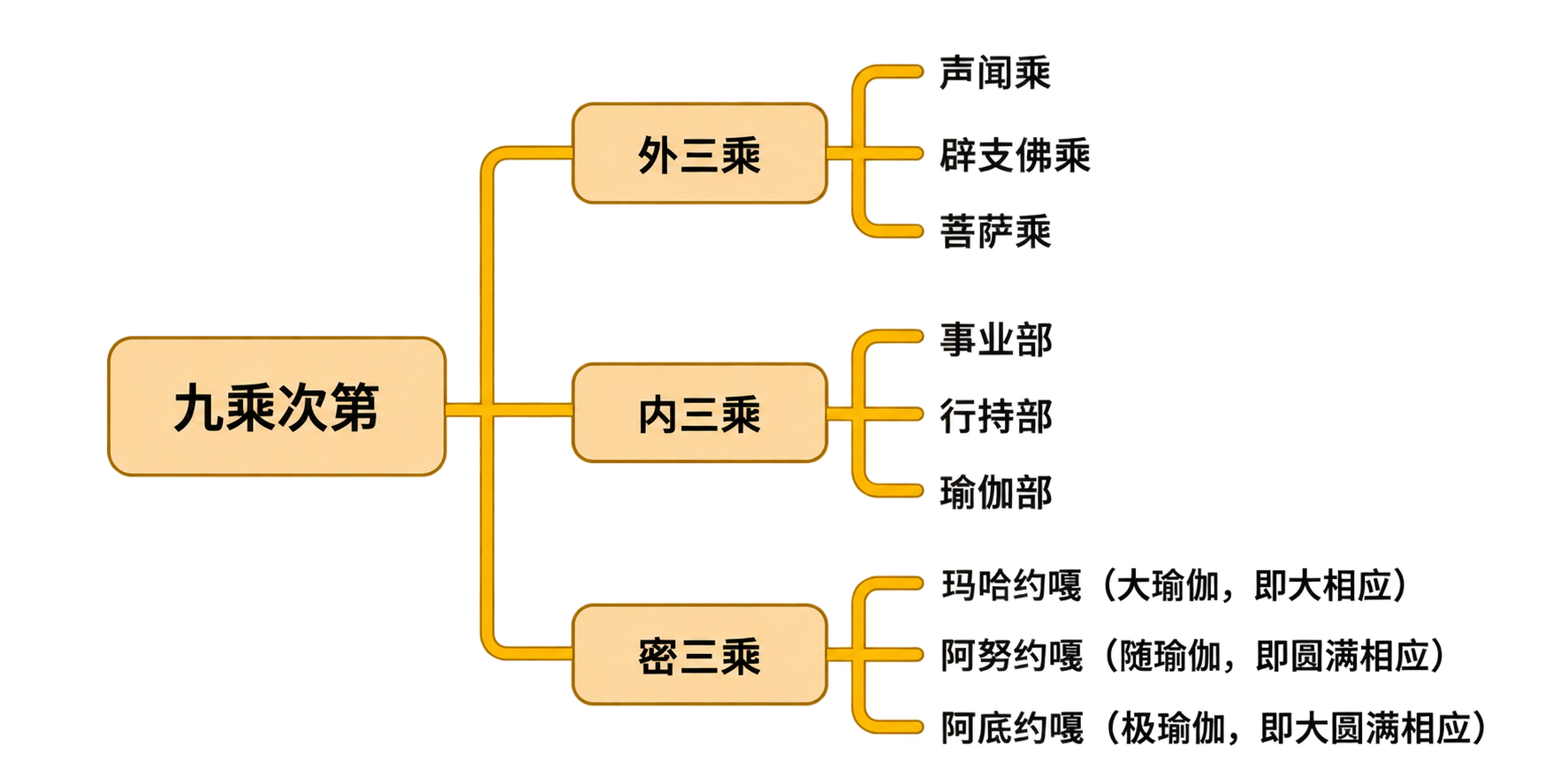 | (see the diagram below):
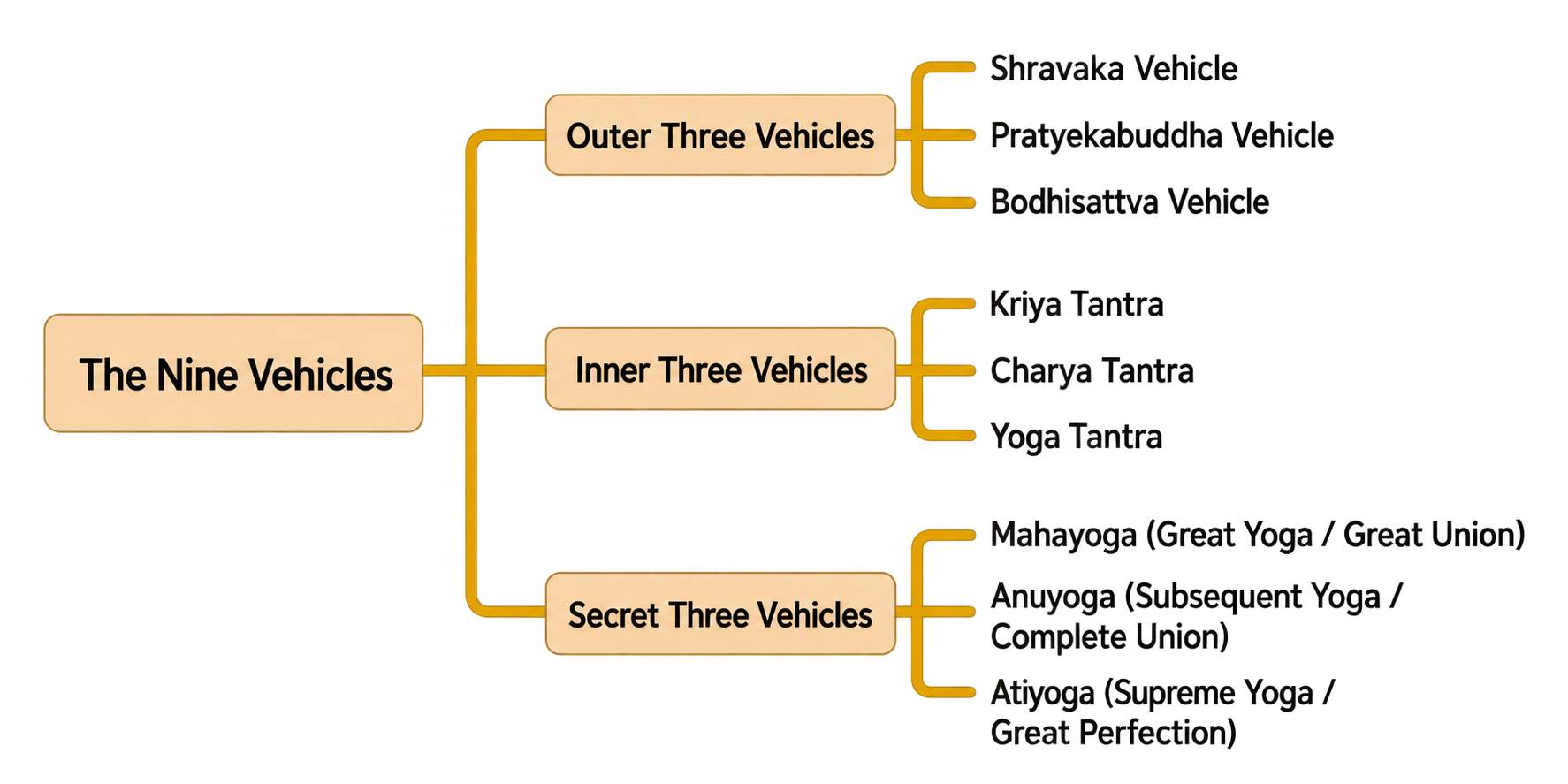 |
|---|
| 外三乘就是显教的声闻、辟支佛和菩萨。主要讲的是教理,让我们明白怎样才能修成罗汉?怎样才能修成辟支佛?怎样才能修成菩萨?如何才能证成佛?先要知道这些教理,然后才能精修密法。 | The Three Outer Vehicles are the exoteric vehicles of the Śrāvaka, Pratyekabuddha, and Bodhisattva. They primarily teach doctrine, enabling us to understand how to attain Arhatship, Pratyekabuddhahood, Bodhisattvahood, and Buddhahood. We must first understand these principles before we can cultivate the esoteric teachings deeply. |
|---|
| 假如我们在修密法前,一点教理都不懂,修起来就很困难。就像我们要去一个地方,先要问清楚路该怎么走,乘什么车,然后才能出发。这样就不会兜圈子走弯路。 | If we know nothing of Buddhist doctrine before practicing the esoteric teachings, practice will be very difficult. It is like traveling somewhere: first we must ask which road to take and which vehicle to use; only then do we set out. In this way, we avoid going in circles and taking unnecessary detours. |
|---|
| 内三乘就是事业部、行持部和瑜伽部,讲的是实修的一些具体方法。事业部(又叫作部),就是一些息灾增益的法。现在世上的灾难很多,息灾法可以帮我们息止灾难(比如地震、火山爆发、水灾、旱灾等)。 | The Three Inner Vehicles are Kriyā, Caryā, and Yoga, which teach specific methods of practice. Kriyā, also known as Kriyā tantra, includes methods of pacification and enrichment. In light of the numerous disasters occurring in the world today—such as earthquakes, volcanic eruptions, floods, and droughts—pacifying methods can help avert these calamities. |
|---|
| 增益法可以帮我们得到某些利益:比如身体健康长寿、减少疾病、财产丰富、五谷丰登等。行持部就是指修初步的观想法。修密法一般开始就是修观想法。 | Meanwhile, enrichment methods can yield benefits like improved health and longevity, reduced illness, wealth, and plentiful harvests. Caryā the esoteric tradition pertains to the initial stages of visualization practice, which is fundamental in esoteric practices. |
|---|
| 比如修“嗡、阿、吽”,就是用白光、红光、蓝光分别观想顶部、喉部、心部。还有‘颇哇法’,首先要从我们的下丹田观想一个仰月坛城(像月牙一样,是向上弯,不是朝下弯,非常明亮。)。 | For example, in practicing “Om Ah Hum,” one visualizes white light, red light, and blue light at the crown, throat, and heart respectively. In the phowa method, one first visualizes in the lower dantian a crescent-moon maṇḍala (like a crescent moon, curving upward, not downward, and very bright). |
|---|
| 从这个基础上起一个脉管,下面小上面大,像一个喇叭口,直通我们头顶的梵穴。要把这个脉管观亮,看着像日光灯一样亮,从会阴直通梵穴。这个脉管底下有一个明点,这个明点就像绿豆大小,比黄豆稍微小一些。 | From this base a channel rises, narrow below and wide above like a trumpet mouth, running straight up to the Brahma aperture at the crown. One must make this channel bright, as bright as a fluorescent tube, from the perineum straight to the Brahma aperture. At the bottom of this channel is a bindu the size of a mung bean, slightly smaller than a soybean. |
|---|
| 月牙、脉管、明点观亮以后,再用三字诀来修。先用‘嘿’字。这个‘嘿’字是从下丹田里喊出来的。一喊‘嘿——’就把下丹田的气都往上提,肛门自然就提起来了。 | After visualizing the crescent moon, channel, and bindu, practitioners use a three-syllable mantra. The first syllable is "Hē," which is uttered in the lower dantian. As "Hē—" is spoken, the qi in the lower dantian rises, naturally lifting the anus. |
|---|
| 密咒就起这个作用,字音鼓气;把气鼓上来,明点就由下面升到顶上了。但不能出去,一出去命就没有了。这个明点就是第八识。 | The mantra facilitates this; the sound invigorates the qi, causing the bindu to ascend from below to the top. However, it must not escape, as doing so could be fatal. This bindu represents the ālaya consciousness (ālaya-vijñāna). |
|---|
| 这时候要观想阿弥陀佛的一只脚(这就叫阿弥陀佛颇哇法)或者观世音菩萨的一只脚(这就叫观音颇哇法)踏在我们顶门梵穴上,明点就出不去了。‘嘿——’气到了顶上,再用‘嘎’字。‘嘎——’气就下来了。 | At this stage, one should visualize one foot of Amitābha Buddha (known as the Amitābha Buddha phowa method) or one foot of Avalokiteśvara Bodhisattva (referred to as the Avalokiteśvara phowa method) resting on the Brahmā aperture to ensure the bindu remains contained. As you chant "Hē—," allow the breath to reach the top of your head, then transition to the syllable "Ga." When you say "Ga—," the breath descends. |
|---|
| 大家可以试一试,‘嘿——’气就上去了,‘嘎——’气就落下来了。到最后要走的时候,就用第三个字,‘啪——’就出去了。 | You can practice this: "Hē—" as the breath rises, followed by "Ga—" as the breath falls. When nearing death, the third syllable, "Phaṭ—," is employed to facilitate the release. |
|---|
| 比如,临终要走时,先用‘嘿——’字把明点升到头顶,然后把阿弥陀佛(或观音菩萨)踏在头顶上的脚拿掉。最后‘啪——’顶开了,这个明点出去,就到阿弥陀佛或观音菩萨的心中,就生到西方极乐世界去了。 | For instance, as you approach death, first use the syllable "Hē—" to elevate the bindu to the top of your head, then remove the foot of Amitābha Buddha (or Avalokiteśvara Bodhisattva) from your head. Finally, chant "Phaṭ—" to open the Brahmā aperture, allowing the bindu to exit into the heart of Amitābha Buddha or Avalokiteśvara Bodhisattva, leading to rebirth in the Western Pure Land of Ultimate Bliss. |
|---|
| 这就是‘颇哇法’。净土宗里面也有观想法,在《十六观经》中就讲了十六种观想法。瑜伽部就是指相应。就是说我们的心要和佛的心相应,心佛道交打成一片,做功夫要言行一致,就是相应。不是说的很多,做的很少,贪嗔痴还是重得很,那就不行。所以要上与佛、下与众生,慈悲喜舍时时刻刻都相应才行。 | This practice is known as the "phowa" method. The Pure Land school offers various visualization methods, as outlined in the Sixteen Contemplations Sūtra, which describes sixteen types of visualization. In the context of Yoga the esoteric tradition, the term "correspondence" signifies that our mind should align with the Buddha's mind; ideally, our mind, the Buddha, and the Way should become one. In practice, it is essential that our words and actions remain consistent—that is, correspondence. Merely talking without taking action, while allowing greed, anger, and ignorance to persist, will not yield results. Therefore, we must maintain correspondence with the Buddha above and all sentient beings below, embodying loving-kindness, compassion, joy, and equanimity at all times. |
|---|
| 密三乘是指玛哈约嘎、阿努约嘎、阿底约嘎。玛哈约嘎(玛哈是大,约嘎是瑜伽)是指通过持真言(即念咒)入定证入妙明境界。这个妙明境界就是指空、乐、明。空就是把身体化空,乐就是乐趣无比,明就是放大光明。 | The Three Secret Vehicles are Mahāyoga, Anuyoga, and Atiyoga. Mahāyoga—mahā means “great”, while yoga means “union”—entails entering samādhi through mantra recitation and realizing a wondrous, luminous state. This state is emptiness, bliss, and clarity. Emptiness means that the body dissolves into emptiness; bliss is incomparable joy; and clarity is the radiance of great light. |
|---|
| 按“四禅八定”的修法,到第二禅天是喜,到第三禅天就是乐,这种快乐是一种轻安宁喜,是世间的任何快乐都无法相比的。证入妙明境界,出现空乐明之后不能有所住着。 | In the practice of the Four Dhyānas and Eight Samādhis, the Second Dhyāna is characterized by joy and the Third Dhyāna by bliss. This bliss is a light, peaceful, and joyful ease beyond comparison with any worldly pleasure. Even after realizing the wondrous, luminous state and experiencing emptiness, bliss, and clarity, we must not abide in them. |
|---|
| 住在空上就不能出空界,住在乐上就不能出欲界,住在明上就不能出色界。所以尽管证到妙明境界也不能住相,要归无所得。 | If we abide in emptiness, we cannot leave the Formless Realm; if we abide in bliss, we cannot leave the Desire Realm; and if we abide in clarity, we cannot leave the Form Realm. Thus, even after realizing this state, we must not cling to its appearances but return to non-attainment. |
|---|
| 阿努约嘎就是圆满相应(阿努是圆满之意),是说佛性本来如此,本来就是妙明境界,任何众生本来都具足空、乐、明,而不是因修法才有的,当一悟到:“噢!佛不是我们修法修成的,而是本来如此!”就开悟了。 | Anuyoga means perfect union: Buddha-nature is originally and naturally this wondrous, luminous state. Every sentient being inherently possesses emptiness, bliss, and clarity; they are not produced by practice. Awakening occurs when we realize, “Ah! A Buddha is not manufactured through our practice; Buddhahood has always been so.” |
|---|
| 所以说道不是修,而是悟。阿底约嘎比阿努约嘎更高了一层。阿底约嘎就是大圆满相应(阿底就是大圆满)。就是说我们本身是佛,本来具足一切妙用,这就是大圆满心要。虹光法,大手印法,还有我们的心中心法等都是大圆满法。 | Thus, the Way is not fabricated through cultivation; it is awakened to. Atiyoga is a level higher than Anuyoga. Atiyoga means union with Dzogchen (Great Perfection), with ati understood here as “great perfection.” In other words, we ourselves are originally Buddhas and already possess every wondrous function. This is the heart essence of Dzogchen. The Rainbow Light practice, Mahāmudrā, and our Heart-of-Heart Dharma are all Dzogchen teachings. |
|---|
| “大圆满”是密宗红教最高的法,和“大手印”是一个法。“大手印”是修“大圆满”的前行,藏文译为“彻却”(意为“立断”)。大手印把我们的本性比做一个大手,尽虚空遍法界。 | The Dzogchen (Great Perfection) is the highest teaching of the Nyingma school of the esoteric tradition and is presented here as the same Dharma as Mahāmudrā. Mahāmudrā is described as a preliminary to the Dzogchen (Great Perfection) and identified with the Tibetan term Trekchö, meaning “cutting through”. Mahāmudrā likens our true nature to a vast hand pervading empty space and the entire Dharma Realm. |
|---|
| 比如孙悟空一个跟头可以翻十万八千里,但翻来翻去还是跳不出如来佛的手掌心。我们的心量就是如此之大,这就是我们的佛性。修“大手印”就是要证成三空相应,也就是要明心见性。三空就是指内虚空、外虚空和密虚空。 | Sun Wukong, for example, can somersault 108,000 li, yet however far he travels, he cannot leap beyond the palm of the Tathāgata. The capacity of our mind is just as vast; this is our Buddha-nature. To practice Mahāmudrā is to realize the union of the three emptinesses—that is, to illuminate the mind and see the true nature. The three are inner emptiness, outer emptiness, and secret emptiness. |
|---|
| 内虚空是指要把我们的身体化空。所以我们常说:修心中心法,身体没有化空还有身体在就不行。外虚空是指身体外的空间。密虚空是指我们的本性,即佛性。我们的佛性本来是空,本来就没有东西。 | Inner emptiness means that the body dissolves into emptiness. This is why we often say that in practicing the Heart-of-Heart Dharma, it will not do if the body remains and has not dissolved into emptiness. Outer emptiness is the space outside the body. Secret emptiness is our true nature, Buddha-nature. Buddha-nature is originally empty and contains no thing. |
|---|
| 没有什么男女老少,青黄赤白。但它又不是断灭空,不是一点东西都没有,而是灵妙真心,就是妙有。妙有者,有而不有,不有而有,无相可见。所以它具有很大的功能,很大的能量。我们将内虚空、外虚空、密虚空化为一体时,就是一个大空。这个大空并非是一点知觉都没有,而是了了分明,灵知了了。这就是彻却界,即大手印。 | It has no male or female, old or young, blue, yellow, red, or white. Yet it is not annihilationist emptiness or sheer nothingness. It is the numinous, wondrous true mind: wondrous presence. Wondrous presence exists without fixed existence and, while not existing as a thing, nevertheless manifests; no form can be seen. It therefore possesses immense function and energy. When inner, outer, and secret emptiness merge into one, there is one great emptiness. This great emptiness is not devoid of awareness; it is lucidly and vividly knowing. This is the realm of Trekchö, namely Mahāmudrā. |
|---|
| 大手印的三要素就是见、定、行。要做到见、定、行三合一。我们首先要见地正确,要明白什么是我们的本性。知道本性是一切众生都具有的,它不生不灭,不增不减,不垢不净,不动不摇。 | The three essentials of Mahāmudrā are view, meditative concentration, and conduct; the three must become one. First, our view must be correct and we must understand our true nature. This nature is possessed by every sentient being. It is unborn and undying, neither increasing nor decreasing, neither defiled nor pure, unmoving and unwavering. |
|---|
| 这样就知道这个世界上的所有东西都是虚妄不实的,都是“因缘所生法,我说即是空”。我们只要把自己所执着的一切东西都放下,恢复我们活活泼泼的本性就成就了。所以见地正确就有了定力。 | We then know that everything in the world is illusory and unreal: “Dharmas arising through causes and conditions, I declare, are emptiness.” We need only let go of everything to which we cling and restore our vivid, dynamic true nature; then attainment follows. Correct view gives rise to the power of concentration. |
|---|
| 因为我们知道外面的色、声、香、味、触、法都是假的,都是不值钱的稻草,就不再着相了。有了佛性这个大宝贝就不要外面的稻草了。我们最珍贵的佛性,在佛经上被誉为“摩尼宝珠”,能予众宝。它能生出一切东西来。 | Knowing that external forms, sounds, smells, tastes, tangibles, and mental objects are false—nothing more than worthless straw—we cease clinging to appearances. Once we possess the great treasure of Buddha-nature, we no longer want the straw outside. The Buddhist scriptures praise our most precious Buddha-nature as a wish-fulfilling jewel capable of bestowing every treasure and giving rise to all things. |
|---|
| 我们的心安定了,行为就能合拍,这就是瑜伽,即相应。假如我们说的是一套,做的是另一套那就不行,因为我们的行为没有修上去。所以“行”就是指要能真正证到。 | When the mind is settled, conduct accords with it. This is yoga: union or correspondence. If we say one thing and do another, it will not do, because our conduct has not caught up with our understanding. “Conduct” therefore means genuinely realizing the teaching in practice. |
|---|
| 修大手印明心见性后,再进一步修大圆满脱嘎法(意为顿超,亦叫虹光法)。禅宗是先开悟,开悟后再在境界上把自己的习气磨光,把所谓的见惑、思惑、尘沙惑、无明惑全磨练光净,一点也不着相了,这样就成就了。 | After practicing Mahāmudrā to realize one's true nature, one further engages in the Dzogchen practice of Tögal, which means sudden transcendence and is also referred to as the Rainbow Light Method. In Chan Buddhism, the process begins with achieving enlightenment, followed by refining one's habitual tendencies related to spiritual states. The procedure involves purifying so-called afflictions of view, thought, innumerable phenomena, and ignorance, ultimately leading to a state of no attachment; this is the method through which enlightenment is attained. |
|---|
| 密宗比禅宗多了一个方便接引法,就是脱嘎法。脱嘎就是用我们身内的五种光和外界的五种光合起来,光光相映,合为一光。我们身内的五种光就是:一、远通水光,就是从我们眼睛里放出的光。 | In contrast, the esoteric tradition provides a more structured form of guidance, specifically through Tögal. Tögal entails the integration of the five lights within our body with the five lights of the external world, facilitating a process where each light reflects and merges into a unified whole. The five lights within our body are as follows: 1.The light emanating from our eyes. |
|---|
| 我们的眼睛不是水汪汪的吗?这是由于有脉管直通到眼睛的缘故。二、白柔脉光,就是各种脉管所放的光。练气功的人不是讲任脉、督脉、中脉等等。这些脉管都放光,就叫白柔脉光。 | Aren't our eyes watery? This light is due to channels that lead directly to the eyes. 2. Light emanates from various channels. Practitioners of qigong discuss the Ren, Du, and Central channels, among others. These channels all emit light, referred to as the light emanating from the white, soft channels. |
|---|
| 三、肉团心光,就是从我们的心脏放出的光。四、法界体性光,就是我们自性的光明。五、界性净光,就是我们的整个身体是一个法界,身体统统是光。外面的五种光就是:太阳光,月亮光,灯光,水光和黑光。 | 3. The light of the physical heart radiates from the heart. 4. The light of the Dharma Realm represents our true nature. 5. The pure light of the realm indicates that our entire body is a Dharma Realm and that the whole body is light. The five external lights include sunlight, moonlight, lamplight, water light, and black light. |
|---|
| 黑暗也是一种光。修虹光法就是用外面这五种光,激发我们身体里面的五种光。我们现在不是有激光吗?就是把能放光的红宝石放在激光盘里面,用强烈的电光打上去,把宝石本身的光激发出来,这就是激光。 | Darkness is also considered a form of light. Practicing the Rainbow Light method utilizes these five external lights to stimulate the five internal lights within our body. Don't we have lasers now? This practice involves placing a luminous ruby in a laser disc and shining a strong electric light on it to stimulate the ruby's own light. |
|---|
| 激光很强能穿透钢板。修虹光法就是用外界的光刺激我们的本性光。这样外面五种光和身内五种光合为一体,就使整个身体由量变到质变,变成一个光明体。 | This device is known as a laser, which is powerful enough to penetrate steel plates. By using external light to stimulate our inherent light, the Rainbow Light method facilitates the merging of the five external lights and the five internal lights into one, resulting in a qualitative change in the entire body that transforms it into a body of light. |
|---|
| 到临终时,“轰——”化成一束光就走了,这就是即身成佛,与即生成佛不同(一个是身体的“身”,一个是生命的“生”)。 | At the time of death, the individual transforms into a beam of light and departs with a "boom." This is called attaining Buddhahood in this very body, which differs from attaining Buddhahood in this lifetime (body vs. life). |
|---|
| 即生成佛是指活在世上这一生能成佛,但临终时没有化成光还有身体遗留下来;如果身体化成光也成佛了,就是即身成佛。 | "Attaining Buddhahood in this lifetime" means achieving Buddhahood in this life without transforming into light at death, thereby leaving behind a physical body. If the body transforms into light and one also attains Buddhahood, it is referred to as "attaining Buddhahood in this very body." |
|---|
| 修成虹光法最好的情况是爪发不留,身心都融于法界而变成光明体;修得不太好的还有指甲和头发留下,其余都化成光了;修得最坏的情况是身体不能化成虹光,而是缩阴,就是身体缩小了。比如供养在九华山百岁宫无暇禅师的报身,就是缩得很小,不足二尺,装金后供在佛龛里面供人瞻仰,那就是缩阴。 | The most successful cultivation of the Rainbow Light method results in the complete complete transformation, leaving behind neither nails nor hair, merging the body and mind into the Dharma Realm, and transforming into a body of light. Less successful cultivation may leave behind nails and hair while the rest transforms into light. The least successful outcome is that the body fails to transform into rainbow light and instead shrinks, becoming smaller. For example, the preserved body of Chan Master Wuxia, enshrined at the Centenarian Palace on Mount Jiuhua, is tiny, measuring less than two feet tall. After being gilded, it is placed in a shrine for people to admire; this process exemplifies the shrinking of the body. |
|---|
| 要修虹光法就不能工作,要闭关,要从早到晚不停的修才行。如果修一修又去上班了,那就不行。因为这个法不是看太阳光就是看水光,不是看水光就是看月光,不是看月光就是看灯光,不是看灯光就是看黑光。 | To practice the Rainbow Light method one cannot go to work; one must go into retreat and practice without stopping from morning to night. It will not do to practice a while and then go off to work, because in this method one is always looking at either sunlight or water light; if not water light, then moonlight; if not moonlight, then lamplight; if not lamplight, then dark light. |
|---|
| 总之要一天到晚打坐修法才能成就,不然就化不成光。所以没有时间或不具备好的外部条件都不能修。比如你现在要看水光,那就必须有水才行啊!所以虹光法修起来很难。 | In short, one must meditate and practice throughout the day in order to attain accomplishment; otherwise, the body cannot transform into light. Those who lack either time or suitable external conditions cannot undertake the practice. If one is to contemplate water light, for example, water must be available. The Rainbow Light method is therefore very difficult to practice. |
|---|
| 即使虹光法修成后,也不能有所住着,如果住着在虹光上,也只不过是法界一游魂,不能圆证佛果。因为佛性本来是空的,我们的心,就象整个大虚空一样一丝不挂,一尘不染。一切相都是我们本来具有的佛性所显现的。 | Even after accomplishing it, one must not abide in the rainbow light. If one clings to it, one remains merely a wandering spirit roaming the Dharma Realm and cannot realize Buddhahood completely. Buddha-nature is originally empty; our mind is like the whole of vast space, utterly unencumbered and unstained by a speck of dust. Every appearance is manifested by the Buddha-nature we inherently possess. |
|---|
| 佛性是具足万相,具足万能的。因为一切都没有,所以才能有一切。佛教的教理是最圆满最彻底的。而其他宗教总有个东西,总有点住着。如果住在一点东西上,其它就不能圆满具足了。 | Buddha-nature contains all appearances and all capacities. Because there is nothing, everything can appear. Buddhist doctrine is the most complete and thorough. Other religions always retain something to cling to; if one abides in any single thing, the whole cannot be perfectly complete. |
|---|
| 可见密宗到最高层和禅宗讲的完全一样,也是无相的,有相法都是导引法,都是初步的摄机法,无相法才是上上法。禅宗其实也是密法,并不是显教。密者就是如来密因,无法可见也。 | At its highest level, the esoteric tradition is therefore exactly the same as Chan: it too is formless. Methods employing forms are means of guidance, preliminary methods adapted to practitioners' capacities; only the formless teaching is supreme. Chan itself is actually an esoteric teaching, not an exoteric one. “Esoteric” refers to the Tathāgata's secret cause, which has no visible form. |
|---|
| 《楞严经》中不是讲:大佛顶如来密因修证了义吗?我们的佛性就是无相可见,无声可闻。既然无声无相又怎么能见到呢?所以说大佛顶是见不到的(只要心心相应就是)。这就是如来密因,这就是秘密。 | Does not the Śūraṅgama Sūtra speak of “the Great Buddha-Crown, the Tathāgata's secret cause, and the complete meaning of cultivation and realization”? Our Buddha-nature has no form to be seen and no sound to be heard. Since it is soundless and formless, how can it be seen? The Great Buddha-Crown cannot be seen; what matters is that mind accords with mind. This is the Tathāgata's secret cause—this is the secret. |
|---|
| 就像惠明问六祖大师:“还有更密的吗?”六祖说:“密在汝边,与汝说者即非密也”。意思是说秘密在你自己,和你讲的就不是秘密。前面我们讲过禅宗有外道禅、凡夫禅、小乘禅、上乘禅、最上乘禅。 | When Huiming asked the Sixth Patriarch, “Is there anything still more secret?”, the Sixth Patriarch replied, “The secret lies with you. Whatever I tell you is no longer secret.” The secret is within oneself; once it is spoken to you, it is no longer secret. Earlier we discussed non-Buddhist Chan, ordinary-beings' Chan, Lesser Vehicle Chan, Superior Vehicle Chan, and Supreme Vehicle Chan. |
|---|
| 外道禅是带异计而修的,心外有法,欣上而厌下,他们不知道上下都是平等的,众生就是佛,佛就是众生;凡夫禅不是带异计而修,是正信因果而欣上厌下;小乘禅是悟了偏空真理而修的,认为这个身体不是我,偏空了;上乘禅(又称菩萨禅)是悟法、我二空之理而修的;最上乘禅就是悟了我们本身就是佛,佛就是我们。 | Non-Buddhist Chan is cultivated with ulterior aims: it posits a dharma outside the mind, delights in what is above, and rejects what is below. Its practitioners do not know that above and below are equal, that sentient beings are Buddhas and Buddhas are sentient beings. Ordinary-beings' Chan is not cultivated with ulterior aims; it is based on right faith in cause and effect, while still delighting in what is above and rejecting what is below. Lesser Vehicle Chan is cultivated after awakening to partial emptiness and recognizing that the body is not the self, but it remains biased toward emptiness. Superior Vehicle Chan, also called Bodhisattva Chan, is cultivated after realizing the emptiness of both person and dharmas. Supreme Vehicle Chan is the realization that we ourselves are Buddhas and Buddhas are none other than us. |
|---|
| 如来自性我们一点也不缺少,同佛一模一样。这样来修就是最上乘禅。这和密宗的大圆满不是一样吗?!所以讲到最高处,密宗和禅宗完全一样。 | We lack nothing of the Tathāgata-nature and are identical with the Buddha in this respect. Cultivation based on this understanding is Supreme Vehicle Chan. Is this not the same as the Dzogchen (Great Perfection) of the esoteric tradition? At the highest point, the esoteric tradition and Chan are exactly alike. |
|---|